


The electronics industry is currently facing a complex environment characterized by:
- Persistent raw material inflation.
- High volatility in metal prices.
- Margin pressure in highly competitive markets.
- Increased requirements for both economic and technical sustainability.
One of the most affected materials is silver (Ag), a fundamental component in standard SAC alloys such as SAC305.
Since silver represents a significant portion of the cost of solder paste, any sustained increase in its market price has a direct impact on unit production costs.
In this context, optimization cannot be limited to logistical or volume adjustments. It requires a technical reassessment of the material itself.
The strategic question is clear:
Can silver content be reduced without compromising assembly reliability?
The Real Impact of Silver Content in SMT Processes
Standard SAC (Sn-Ag-Cu) alloys, such as SAC305, contain approximately 3% silver. In high-volume SMT production, this proportion represents a significant share of the total alloy cost.
Low SAC alloys (such as SAC105 or SAC0307) significantly reduce that percentage, resulting in:
- Direct reduction in cost per kilogram of solder paste.
- Lower exposure to precious metal market volatility.
- Improved budget predictability in serial production.
However, the analysis cannot remain purely economic. Reducing Ag content directly modifies the solidified joint microstructure and the morphology of intermetallic phases.
This transition is not simply a “low-cost substitution,” but a technical decision supported by specific metallurgical behavior.
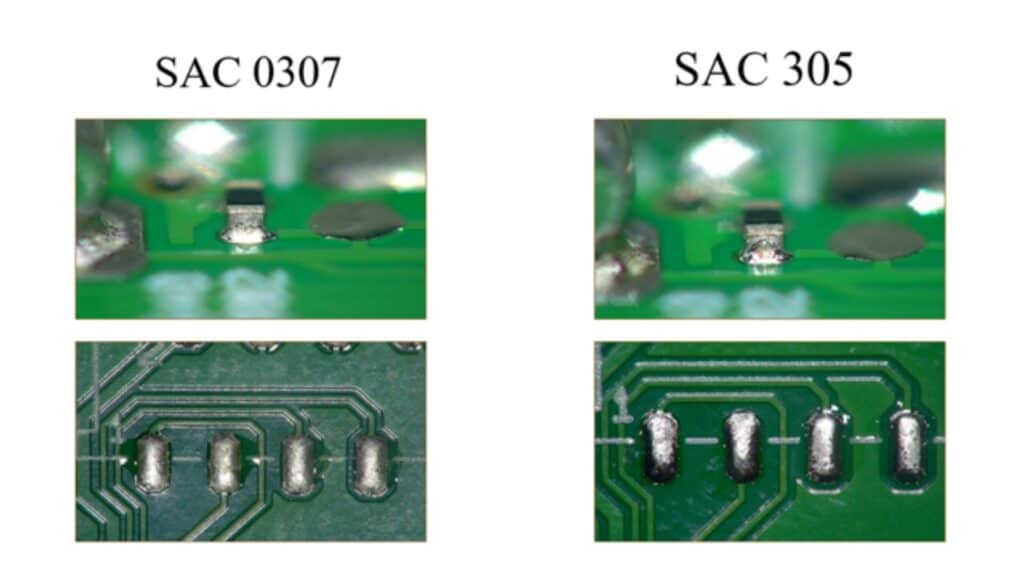
Technical Comparison: SAC305 vs Low SAC (SAC0307)
From a microstructural perspective, the difference between SAC305 and Low SAC is clear.
In SAC305:
- Higher fraction of Ag₃Sn intermetallic compounds.
- More rigid microstructure.
- Strong performance under long-term thermal fatigue.
In Low SAC (SAC0307):
- Lower density of silver-based intermetallics.
- More ductile matrix.
- Greater energy absorption capacity under impact loading.
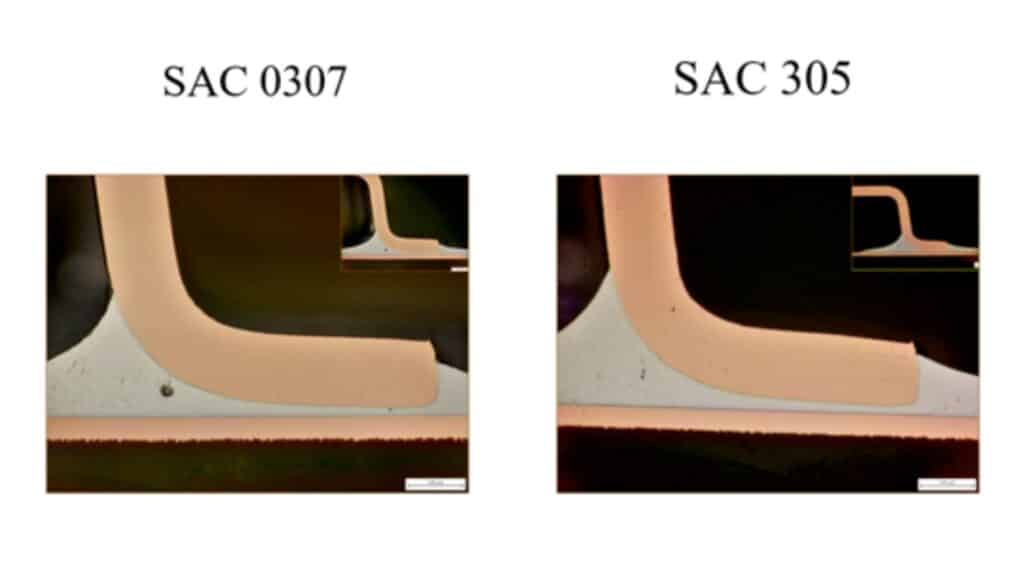
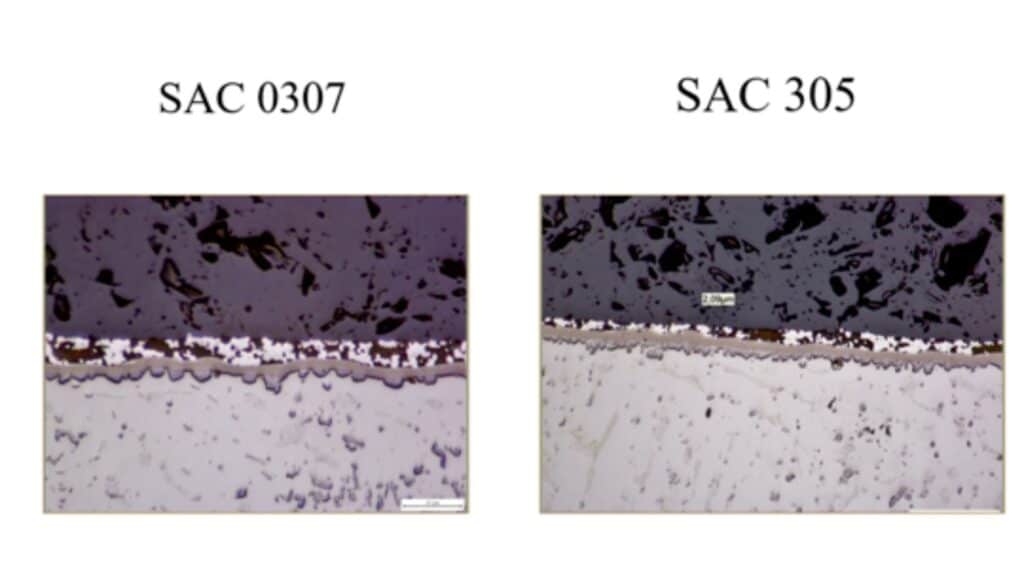
The comparative images clearly illustrate differences in intermetallic phase distribution and density, as well as variations at the pad-solder interface.
Strategic Recommendation Based on Application Profile
The transition to Low SAC alloys is particularly suitable for products where the dominant failure mode is associated with localized mechanical stresses, such as impacts or PCB flexing.
This is typically the case for smartphones, tablets, wearables, IoT devices, and a large portion of portable consumer electronics. In these applications, drop and shock events generate short-duration but high-intensity dynamic loads.
Conversely, in applications where the dominant degradation mechanism is cumulative thermal fatigue—such as automotive systems, industrial electronics, or equipment exposed to wide thermal excursions over many years—standard SAC remains a solid reference. Its higher rigidity and greater intermetallic fraction can contribute to improved performance under prolonged and repetitive thermal cycling.
Ultimately, the choice should not be approached as a general substitution, but as a decision aligned with the actual load profile of the product and its lifetime requirements.
Would you like to assess whether your product can transition to Low SAC without compromising reliability?
At NUFESA, we can coordinate a qualification trial tailored to your specific application profile and jointly analyze the technical and economic impact.
Request a technical evaluation trial
